
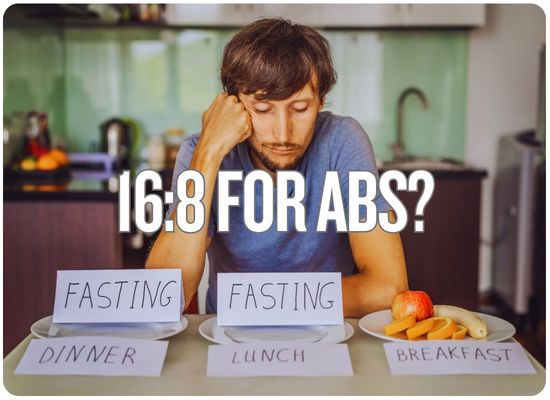
Several new meta-analyses now give a much better answer than “fasting works” or “fasting is pointless.” An eight-hour eating window may help some people get leaner—but the advantage looks modest, inconsistent and heavily dependent on what happens inside those eight hours.
Recent athlete and exercise meta-analyses suggest that time-restricted eating can produce small reductions in body weight or body-fat percentage while generally preserving lean mass and strength.
But the newest resistance-training review found no clear overall superiority over conventional eating. The most useful interpretation is that an eight-hour window can make a diet easier to control for some people—not that fasting somehow instructs the body to uncover the abs first.
That review included 15 trials and 511 participants. The authors described the added effect as small and short-term and cautioned that the evidence base remains limited.
Sixteen hours without calories. Eight hours in which you eat.
A 16:8 time-restricted eating schedule compresses the day’s meals into roughly eight hours and leaves the remaining sixteen hours calorie-free. It does not require one universal clock schedule. A noon-to-8 p.m. window is common, but an earlier window can also qualify.
When researchers isolated resistance training, fasting was not clearly superior.
A new systematic review and meta-analysis looked specifically at healthy adults performing resistance training while following time-restricted feeding or a conventional eating pattern.
Only randomized controlled trials with resistance training were included.
The evidence base was small, which limits how definitive the result can be.
Pooled difference, with a confidence interval crossing zero: no statistically significant advantage.
Only two studies individually showed significant differences for body weight or fat mass.
People in both fasting and conventional-feeding groups can lose fat, gain strength or preserve muscle. The review’s point is narrower: the compressed eating window did not consistently outperform ordinary feeding when resistance training was part of the program.
In athletes, the scale and body-fat percentage moved slightly in fasting’s favor.
A separate meta-analysis published September 23 pooled 16 studies from 15 articles involving 245 athletes. It compared time-restricted eating with non-time-restricted diets while examining body composition and performance.
| Outcome | TRE result vs control | Statistically significant? | What that means |
|---|---|---|---|
| Body mass | Small reduction | Yes | Pooled standardized effect size: −0.27. |
| Body-fat percentage | Small reduction | Yes | Pooled effect size: −0.39. |
| Fat mass | Small reduction | No | The confidence interval crossed zero. |
| Lean mass | Trivial difference | No | No clear pooled loss of lean mass. |
| Muscular strength | Essentially unchanged | No | Pooled effect size was effectively zero. |
| Power | Small nonsignificant difference | No | No clear performance penalty or advantage. |
Fifteen trials found a small extra fat-loss effect when 16:8 was combined with exercise.
A May 2026 meta-analysis focused specifically on studies using a 16-hour fast and eight-hour eating window together with structured exercise.
Average pooled difference favoring 16:8 plus exercise over exercise alone.
Average pooled difference favoring 16:8 plus exercise.
Meta-analysis averages come from different populations, exercise programs, intervention lengths and diet controls. They estimate an average study effect, not what one individual will lose by switching breakfast for black coffee.
Only if the eating window improves the part of the diet that actually determines your progress.
Visible abs depend on more than a fasting clock. Abdominal muscle development, total body-fat level, individual fat distribution, water balance and even digestion affect how much definition you see.
The window can remove eating opportunities.
If skipping late-night snacks or delaying the first meal makes it easier to eat less without feeling constantly restricted, 16:8 can indirectly speed fat loss.
Keeping muscle matters during an abs-focused cut.
Resistance training and sufficient protein are important because revealing the abs is more useful when the abdominal and surrounding musculature is preserved.
A theoretically perfect diet that you hate loses quickly.
If fasting causes evening overeating, poor training sessions or constant hunger, the eating window has stopped being a shortcut.
The clock becomes less magical.
One useful resistance-training experiment directly compared a 16:8 schedule with a normal meal distribution under hypocaloric, high-protein conditions. When food intake and protein were controlled, four weeks of 16:8 did not produce superior body- composition changes.
The latest athlete data are reassuring—but not a blank check.
The September athlete meta-analysis did not find a statistically significant overall loss of lean mass with time-restricted eating. Muscular strength was also essentially unchanged.
The standardized effect was small and nonsignificant. However, evidence certainty was low, and sensitivity analysis introduced some uncertainty.
That is essentially a zero difference between time-restricted eating and comparison diets in the pooled athlete data.
Compressing meals into eight hours is only useful if you can still eat enough protein, carbohydrate and overall energy to support training and recovery. The goal of an abs-focused cut is usually to lose fat while preserving as much performance and lean tissue as practical—not to see how little food can fit into one afternoon.
Fasting can work with weights—and still make training feel harder.
A controlled study in well-trained men and women compared a 16:8 schedule with a conventional feeding pattern during eight weeks of supervised resistance exercise. Both groups were assigned the same high-protein calorie surplus.
Both groups added fat-free mass.
The eating window did not prevent gains in fat-free mass during progressive resistance training.
The fasting group completed less total exercise volume.
The difference raises a practical question for people whose compressed eating window interferes with workout energy.
Daily energy ratings were lower.
Even when the diet “works,” the schedule may not be ideal if it consistently makes training feel flat.
16:8 versus a normal eating schedule for an abs-focused cut.
Best suited to someone who naturally prefers fewer, larger meals or wants a hard stop on evening eating.
- Keep all calorie-containing food inside an eight-hour window.
- Fit multiple meaningful protein servings inside the window.
- Place at least some food reasonably close to demanding resistance training if performance suffers when fasted.
- Do not “reward” the fast with an uncontrolled eight-hour eating spree.
- Judge the method by hunger, training performance and weekly progress—not fasting-hour bragging rights.
Best suited to someone who trains early, prefers breakfast or feels better spreading meals across the day.
- Eat across a normal waking-day schedule.
- Maintain the same overall fat-loss objective.
- Spread protein and carbohydrates around training as desired.
- Control portions without imposing a fasting clock.
- Judge the method by the exact same measures: consistency, body trend and gym performance.
The objective is not to cram an entire day of nutrition into one giant dinner.
First substantial meal with protein, carbohydrate, produce and enough food to actually support the day.
Pre-training meal or snack if desired, particularly when training quality falls when under-fueled.
Resistance workout: keep progressive lifting as the signal telling the body that muscle remains useful.
Recovery meal and final meal/snack while completing the day’s protein and overall nutrition targets.
Someone who trains at 6 a.m. may prefer a much earlier eating window—or may simply perform better without time-restricted eating. The fasting schedule should adapt to the training plan, not force the entire training plan to adapt to fasting.
The clock can look perfect while the cut goes nowhere.
A compressed window does not guarantee lower intake. Large portions, liquid calories and calorie-dense snacks can erase the apparent advantage quickly.
The goal is not merely to “hit protein sometime before 8 p.m.” A practical resistance-training diet still benefits from multiple useful opportunities to consume protein.
If loads, repetitions, energy and training volume repeatedly fall because the workout occurs too deep into a fast, the supposed shortcut may be fighting the muscle-preservation side of the equation.
More fasting is not automatically better. Extremely restrictive schedules can make fueling, social eating and recovery harder without evidence that they reveal abs in proportion to the extra fasting hours.
16:8 works best when the schedule solves a real eating problem.
| Situation | 16:8 fit | Reason |
|---|---|---|
| Constant evening snacking derails the cut | Potentially excellent | A hard end to the eating window removes the period where most excess calories occur. |
| Naturally not hungry at breakfast | Good | The schedule may simply formalize a pattern that already feels easy. |
| Early-morning high-volume training | Depends | Delaying food for hours after hard training may make the schedule unnecessarily awkward. |
| Hunger becomes extreme during long fasts | Poor fit | A method that consistently causes rebound eating is not making adherence easier. |
| Already controlling calories easily | Optional | There may be little reason to impose a clock when the conventional approach is already working. |
16:8 may reveal your abs faster—but probably because it changes how you eat, not because 16 fasting hours unlock a secret abdominal-fat pathway.
The freshest 2026 evidence points in two directions that are not actually contradictory.
First, time-restricted eating can produce small improvements in body weight or body-fat percentage in some active and athletic populations. Dedicated 16:8 analyses have also found modest average fat-loss advantages when the strategy is paired with exercise.
Second, the newest resistance-training review does not show that fasting consistently beats a conventional eating pattern. Lean-mass and strength outcomes are generally similar when training and nutrition are maintained.
So the Sixpack shortcut is not “fast for 16 hours and burn more belly fat.” It is: use 16:8 if an eight-hour eating window makes a controlled, high-protein, resistance-training cut easier to follow.
If the same window makes you weak in the gym, ravenous at night or unable to eat well, conventional meal timing can get you to the same destination.
Sources
- Verdi AMOH, Soares JM, Andrade MJ, Mazur CE, Gonçalves DC. Time-restricted feeding with resistance training is not superior to conventional feeding for body composition and muscle strength: a systematic review and meta-analysis. Anais da Academia Brasileira de Ciências. October 9, 2026. DOI: 10.1590/0001-3765202620240672. PMID: 42879592.
- Lin R, Wang Y, Shuai Z, Zhou K, Wu W. Effects of time-restricted eating on body composition and performance in athletes: a systematic review and meta-analysis. Frontiers in Nutrition. September 23, 2026. DOI: 10.3389/fnut.2026.1956159. PMID: 42847018.
- Liu H, Hu G, Ma X. Effects of combining exercise with a 16:8 time-restricted eating protocol on body composition and glucose-lipid metabolism in adults: a systematic review and meta-analysis. Frontiers in Nutrition. May 14, 2026. DOI: 10.3389/fnut.2026.1816555. PMID: 42221753.
- Ali AM, et al. Time-restricted eating shows a modest reduction in fat mass in resistance-trained individuals: a systematic review and meta-analysis. Nutrition Research. 2026. PMID: 41687432.
- Tinsley GM, et al. Hypercaloric 16:8 time-restricted eating during 8 weeks of resistance exercise in well-trained men and women. Journal of the International Society of Sports Nutrition. 2025. PMID: 40241374.
- Tinsley GM, et al. Four Weeks of Time-Restricted Feeding Combined with Resistance Training Does Not Differentially Influence Measures of Body Composition, Muscle Performance, Resting Energy Expenditure, and Blood Biomarkers. Nutrients. 2020;12(4):1126.
- Gavanda S, et al. Time-Restricted Eating during a Bulking Phase Is Associated with Reduced Fat Accumulation, while Muscle and Strength Gains Are Maintained: A 12-Wk Randomized Controlled Trial. The Journal of Nutrition. 2026. DOI: 10.1016/j.tjnut.2026.101722. PMID: 42442697.
Research reviewed through October 22, 2026. “Visible abs” is not a standardized research endpoint, so this report applies body-composition and resistance-training findings to an abs-focused fitness goal. Individual fat distribution and abdominal definition vary substantially. Time-restricted eating may be inappropriate for some people, including those with a history of disordered eating or certain medical, medication, pregnancy or nutritional circumstances; individualized medical questions should be discussed with an appropriate clinician.
Is fasting actually likely to make your cut easier?
This does not estimate fat loss. It checks whether the structure of 16:8 matches the eating and training problems you are actually trying to solve.