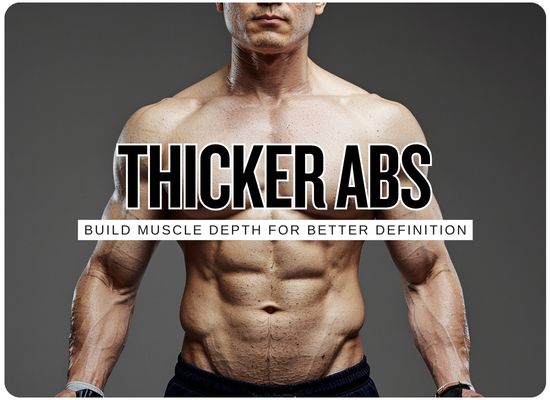
Thicker abs can move the visibility line, but they cannot beat a thick fat layer
The old gym saying has some truth: a bigger muscle is easier to see. But abdominal definition is still a two-part problem. You need enough muscle pushing the shape outward and little enough subcutaneous fat sitting over it.
Ab depth plus fat-layer thickness
Think of visible abs like raised lettering under a blanket. Make the letters taller and they show sooner. Make the blanket thinner and they show clearer. Do both and the midsection changes fast.
The clean answer
Yes, you can build thicker abs so they show at a slightly higher body-fat percentage. The realistic gain is not magic. It is better definition at the same waist size, especially in the upper abs and obliques. If the lower-belly layer is still thick, training alone will not reveal a six-pack.
The quick comparison
| Situation | Best interpretation | Best move |
|---|---|---|
| Flat stomach, weak ab lines | Muscle depth may be the limiter | Build abs with progressive resistance |
| Visible upper abs, soft lower belly | Fat layer is still the main limiter | Small deficit, keep ab training |
| Thin body, no definition | Low muscle mass and weak trunk development | Recomp or lean bulk |
| Good abs flexed, gone relaxed | Close, but not fully revealed | Build thickness and reduce waist slowly |
| Big waist, strong core | Strength is not the same as visibility | Fat loss must lead |
Hypertrophy needs progression, not endless burnouts
Ab muscles respond to the same broad principle as other muscles: repeated tension that progresses over time. High-rep crunch burnouts can make the abs sore, but soreness is not the target. The target is measurable overload.
- Add load to cable crunches, machine crunches or weighted decline crunches.
- Progress reverse crunches, hanging knee raises and ab-wheel rollouts carefully.
- Train close enough to fatigue that the set has a reason to adapt.
- Keep the spine and pelvis controlled so the hip flexors do not steal the work.
The rectus abdominis needs both curl and pelvis control
The six-pack muscle flexes the trunk and helps control the pelvis. That means a complete ab-building plan should not be only planks, and it should not be only sloppy leg raises. The best plan covers both top-down and bottom-up action.
- Top-down: cable crunch, machine crunch, decline crunch.
- Bottom-up: reverse crunch, hanging knee raise, captain’s chair raise.
- Anti-extension: ab wheel, body saw, long-lever plank.
- Anti-rotation: Pallof press, suitcase carry, slow shoulder taps.
Obliques can sharpen the waist, but chasing size has a limit
Obliques help create the side lines, torso stiffness and athletic waist shape. They deserve training. But if the only goal is a narrow visual waist, heavy side bends every week may not be the best lead exercise.
- Use suitcase carries and Pallof presses for bracing without sloppy twisting.
- Use side planks and Copenhagen side planks for lateral trunk control.
- Use rotation work if sport performance matters.
- Keep waist measurement as the visual guardrail.
The body-fat percentage trap
Do not build the whole plan around a single percentage. Two people at the same estimated body fat can look different because of abdominal muscle thickness, fat distribution, rib cage shape, posture, skin thickness, lighting and where the last fat layer sits.
The ab-building dose
| Training variable | Practical target | Simple rule |
|---|---|---|
| Frequency | 2 to 4 direct ab sessions weekly | Recover enough to progress, not just repeat soreness |
| Hard sets | 6 to 12 direct sets weekly to start | Add slowly if recovery and form stay good |
| Rep range | 8 to 20 reps for most loaded moves | Use lower reps for heavy control, higher reps for clean tension |
| Progression | More load, better range, slower control or more reps | Only count progress that keeps the abs doing the work |
| Nutrition | Protein consistent, calories matched to phase | Cut if waist is high, build if muscle is the limiter |
The 4-move thicker abs plan
| Move | Job | Starting dose | Progression |
|---|---|---|---|
| Cable crunch | Loaded spinal flexion for upper and mid abs | 3 sets of 10 to 15 | Add weight when all reps stay controlled |
| Reverse crunch | Pelvis control and lower-ab focus | 3 sets of 8 to 15 | Slow eccentric, then add incline or hanging variation |
| Ab wheel or body saw | Anti-extension and deep bracing | 2 to 3 sets of 6 to 12 | Increase range without low-back sag |
| Suitcase carry or Pallof press | Obliques, anti-rotation and waist control | 2 to 3 sets per side | Add load or time while staying tall |
The best phase choice
If your waist is still clearly above your target, cut slowly while training abs hard. If your waist is already tight but the stomach looks flat and line-free, recomp or lean bulk may reveal more than another crash diet.
The decision table
| Mirror signal | Scale or waist signal | Likely limiter | Next 8 weeks |
|---|---|---|---|
| Flat stomach, no grooves | Waist already lean | Ab thickness | Recomp with progressive core training |
| Upper abs visible only | Waist still moving down | Lower abdominal fat | Continue small deficit |
| Abs visible flexed only | Waist stable | Both muscle and fat layer | Recomp or short cut based on hunger and strength |
| No lines, soft waist | Waist above target | Fat layer | Cut while preserving strength |
| Lines improving, lifts rising | Waist controlled | Plan is working | Do not change too much |
Thicker Abs or Leaner Waist Tool
Use this quick filter to decide whether your next phase should build ab thickness, cut the fat layer or do both slowly.
Your best next phase
The hard limit
Thicker abs can improve definition, but they cannot out-muscle a large abdominal fat layer. If waist measurement is not improving, more crunches will not solve the visibility problem.
Reader references
Useful reader-facing references include the ACSM resistance-training position stand, the full ACSM resistance-training overview, the ISSN protein and exercise position stand, the ultrasound study on deep abdominal muscle thickness, the rectus abdominis ultrasound exercise comparison, and the resistance exercise during dietary weight loss meta-analysis.