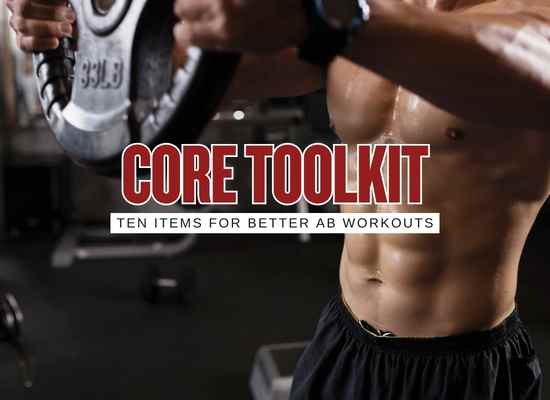
A home ab setup does not need to look like a commercial gym. The best toolkit is built around leverage, friction, instability, load, range of motion, and progression. That matters because visible abs are not created by endless crunches alone. They come from a mix of lower body fat, full-body strength, direct core training, and consistency. Current public-health guidance still recommends at least 150 minutes of moderate-intensity activity weekly plus 2 days of muscle-strengthening activity, while ACSM’s 2026 resistance-training update emphasizes that regular participation matters more than complicated programming for most adults. Core stability work also has research support for some people with chronic nonspecific low-back pain, which makes exercise selection and control especially important for home training.
A stronger core does not require a full gym
A six-pack home setup works best when every item has a job. Some items add load. Some create instability. Some help with anti-rotation, range of motion, bracing, or grip. The right toolkit turns a living room, garage, bedroom, or patio into a serious core-training space without wasting money on bulky machines.
Safety note: Ab training should not create sharp back pain, neck strain, dizziness, numbness, or symptoms that feel unusual. People with hernias, pregnancy or postpartum concerns, recent surgery, spine conditions, high blood pressure, or major health changes should get individualized guidance before adding harder loaded core drills.
Each item adds a different training advantage: load, reach, friction, instability, height, grip, or progression.
A practical baseline is at least two weekly muscle-strengthening days, with core work layered into the plan.
Train the trunk to resist extension, resist rotation, and transfer force, not just crunch forward.
The smarter home-core standard
The home-fitness trap is buying random gadgets because they look intense. A better approach starts with the movement problem. Are you missing load? Use a dumbbell, kettlebell, backpack, or sandbag. Are you missing anti-rotation? Use a resistance band. Are you missing sliding friction? Use sliders or towels. Are you missing range of motion? Use a bench, box, step, or stability ball.
For visible abs, the toolkit should support the whole process. Direct core work matters, but the final look also depends on full-body resistance training, enough movement to support fat loss, enough protein to maintain muscle, and a routine that can be repeated for months. Home items should make the plan easier to repeat, not more complicated.
The home toolkit rule
Buy or use items that solve a training problem. Skip items that only make the workout look harder without improving control, load, range of motion, or consistency.
The 10 home items
Resistance bands
Resistance bands are one of the highest-value home items for ab training because they create tension in directions bodyweight alone cannot. They are especially useful for anti-rotation work, standing core drills, chops, lifts, resisted dead bugs, and Pallof presses. That makes them a strong choice for people who want core training that feels athletic instead of endless floor crunches.
The biggest advantage is directional resistance. A band anchored to a door, rack, post, or heavy stable object can pull the torso sideways, diagonally, or forward. The abs then have to brace and resist movement. That is useful because the core’s job in real life is often to control force, not just bend the spine repeatedly.
- Use for Pallof presses, band chops, band lifts, resisted dead bugs, and anti-rotation holds.
- Choose lighter resistance first so the ribs, pelvis, and spine stay controlled.
- Check the anchor before every set because a loose band can snap back dangerously.
- Progress by stepping farther from the anchor, slowing the tempo, or increasing hold time.
Adjustable dumbbell or single dumbbell
A dumbbell gives home ab training something many bodyweight routines lack: load. Loaded core drills can build stronger bracing, better trunk control, and a more athletic waist. A single dumbbell can support suitcase carries, weighted dead bugs, dumbbell pull-throughs, goblet squats, farmer carries, wood-chop patterns, and controlled weighted crunch variations.
The most underrated dumbbell ab exercise is the suitcase carry. Hold one dumbbell at your side and walk slowly while keeping the torso tall. The weight tries to pull you sideways. Your obliques, deep core, grip, and hips have to stabilize. It is simple, measurable, and far more useful than rushing through sloppy side bends.
- Use for suitcase carries, farmer carries, goblet squats, dead bugs, and controlled loaded crunches.
- Start with a weight that allows smooth breathing and tall posture.
- Do not twist or lean to “feel” the movement more.
- Progress by adding distance, time, weight, or slower walking speed.
Kettlebell
A kettlebell overlaps with a dumbbell, but it brings a different feel because the weight hangs below the handle. That makes it useful for carries, deadlifts, goblet squats, rack holds, halos, and controlled swing progressions for people who already know safe hinge mechanics. For abs, the kettlebell is not magic. Its value comes from loaded bracing.
A simple kettlebell deadlift can be more useful for the midsection than a long list of random ab moves because it teaches the trunk to stay stiff while the hips produce force. Rack carries and front-loaded holds also challenge the abs without requiring the person to lie on the floor.
- Use for deadlifts, rack carries, goblet holds, halos, and front-loaded marches.
- Master slow deadlifts before explosive swings.
- Keep the ribs stacked over the pelvis during carries and holds.
- Avoid high-rep swings if the lower back takes over or technique breaks down.
Ab wheel
The ab wheel is small, cheap, and extremely effective when used correctly. It is also one of the easiest home tools to misuse. The rollout trains anti-extension: the abs resist the lower back from sagging as the arms reach forward. That is a serious core demand, which is exactly why beginners often need a progression before full rollouts.
The safest starting point for many people is a short-range kneeling rollout into a wall. The wall stops the wheel before the body gets too long. Over time, the user can move farther away. This keeps the exercise challenging without turning every rep into a lower-back stress test.
- Start with wall-stopped kneeling rollouts.
- Keep the ribs down, glutes lightly squeezed, and lower back from sagging.
- Stop the set when the abs can no longer control the return.
- Skip full standing rollouts unless you already have advanced core strength.
Sliders or towels
Sliders are one of the easiest ways to make bodyweight ab training more effective at home. On hard floors, towels can work. On carpet, furniture sliders may work better. The key is friction control. Sliding movements make the abs work while the arms or legs move away from the center of the body.
Sliders are excellent for body saws, mountain climbers, knee tucks, plank reaches, hamstring curls, and slow pikes. They also scale well. A beginner can use short ranges and slower reps. A more advanced person can use longer ranges, single-leg variations, or longer time under tension.
- Use for plank body saws, slider knee tucks, slow mountain climbers, and pikes.
- Keep reps slow enough that the hips do not bounce or sag.
- Use a mat under the elbows for comfort during body saws.
- Progress by increasing range before increasing speed.
Pull-up bar or captain’s-chair alternative
Hanging core work can be powerful because it challenges grip, shoulders, lats, hip flexors, and abs together. A doorway pull-up bar can support hanging knee raises, active hangs, scapular control, and slow tuck holds. For people without a bar, a sturdy captain’s-chair station or dip station can create a similar knee-raise pattern.
The common mistake is swinging. A hanging knee raise should not look like a leg-swing contest. The better version starts with a controlled hang, ribs down, pelvis slightly tucked, and knees moving slowly. If grip fails first, use shorter sets. If shoulders feel irritated, choose floor-based reverse crunches instead.
- Use for hanging knee raises, active hangs, tuck holds, and controlled leg-lift progressions.
- Start with bent knees before straight-leg raises.
- Control the lowering phase instead of dropping the legs.
- Make sure the bar is installed correctly and rated for use.
Stability ball
A stability ball adds instability and range of motion, which can make simple exercises more demanding. ACE notes that choosing a ball size should allow the user to sit with feet flat, thighs parallel to the floor, and hips and knees around 90 degrees. That fit matters because an oversized or undersized ball can make exercises awkward instead of useful.
For abs, the stability ball is strong for rollouts, stir-the-pot, ball dead bugs, crunches with support, pikes, and hamstring curls. It is especially useful for people who want a tool that can support both core and mobility work. The challenge is to move slowly enough that the instability trains control rather than chaos.
- Use for ball rollouts, stir-the-pot, pikes, supported crunches, and hamstring curls.
- Pick a ball size that lets you sit comfortably with hips and knees near 90 degrees.
- Keep the neck relaxed during ball crunches.
- Progress by increasing range, not by bouncing faster.
Yoga mat or thick exercise mat
A mat sounds basic, but it can decide whether people actually train. Hard floors make dead bugs, side planks, hollow holds, reverse crunches, and breathing drills uncomfortable. A quality mat makes floor work repeatable, and repeatability beats novelty.
The mat also creates a training zone. That matters for home consistency. When the mat comes out, the session starts. It reduces friction, protects knees and elbows, and makes it easier to do short core finishers even when a full workout feels unrealistic.
- Use for dead bugs, side planks, reverse crunches, hollow holds, and breathing drills.
- Choose enough cushion for knees and elbows without being so soft that balance becomes unstable.
- Keep it visible if you need a reminder to train.
- Clean it regularly, especially after sweaty sessions.
Backpack, sandbag, or duffel bag
A loaded backpack or duffel bag is the budget version of a sandbag. It can add serious core value because the load may shift slightly, forcing the trunk to stabilize. This is useful for carries, bear-hug squats, front-loaded marches, plank drag variations, and loaded get-up progressions.
The key is packing it safely. Use soft items, books, or sealed bags inside so the load does not have sharp edges. Keep it close to the body for front-loaded drills. For carries, start lighter than expected because awkward loads challenge grip and posture quickly.
- Use for bear-hug carries, front-loaded squats, plank drags, and loaded marches.
- Pack the load evenly and avoid sharp corners against the body.
- Use shorter sets at first because shifting loads can fatigue the trunk quickly.
- Do not use a flimsy bag that may tear or spill during movement.
Step, bench, box, or sturdy chair
A stable elevated surface adds angles that the floor cannot provide. It can make some moves easier, such as incline planks and elevated mountain climbers, or harder, such as decline plank variations, bench reverse crunches, and feet-elevated body saws. For home abs, height is a progression tool.
The safety point is stability. A chair that slides, wobbles, or tips is not a training tool. A sturdy bench, aerobic step, low box, or heavy chair against a wall is better. The surface should support bodyweight without movement.
- Use for incline planks, decline planks, step mountain climbers, reverse crunches, and supported split squats.
- Use incline versions to make exercises easier and decline versions to make them harder.
- Place the surface against a wall if sliding is possible.
- Avoid fast movements on unstable furniture.
The toolkit comparison table
This table organizes the 10 items by training job, beginner value, space demand, and the main mistake to avoid.
| Home item | Best core job | Beginner value | Space demand | Main mistake |
|---|---|---|---|---|
| Resistance bands | Anti-rotation and diagonal resistance | High | Very low | Using too much tension and twisting through the torso |
| Single dumbbell | Loaded bracing and carries | High | Low | Choosing load before posture is controlled |
| Kettlebell | Loaded holds, carries, hinges | Medium to high | Low | Rushing into swings before hinge technique is ready |
| Ab wheel | Anti-extension | Medium | Very low | Rolling too far and sagging the lower back |
| Sliders or towels | Friction-based plank movement | High | Low | Going fast instead of staying controlled |
| Pull-up bar | Hanging knee raises and grip-supported core work | Medium | Low | Swinging the legs instead of controlling the pelvis |
| Stability ball | Instability and range of motion | Medium | Medium | Bouncing through reps instead of stabilizing |
| Exercise mat | Comfort, consistency, and floor control | Very high | Low | Ignoring it because it seems too basic |
| Loaded backpack or sandbag | Awkward-load bracing | Medium | Low | Packing it unevenly or too heavy |
| Step, bench, box, or chair | Angle changes and range of motion | High | Low to medium | Using furniture that slides or tips |
The best first three
For most home users, the strongest starter bundle is a mat, resistance bands, and one adjustable dumbbell or loaded backpack. That combination covers comfort, anti-rotation, loaded bracing, and basic full-body strength without taking over the room.
The three core jobs your toolkit should cover
Most ab routines over-focus on spinal flexion, which is the crunching pattern. That is not useless, but it is incomplete. A better home toolkit covers three core jobs.
| Core job | Plain-language meaning | Useful home items | Example moves |
|---|---|---|---|
| Anti-extension | Stop the lower back from sagging as the body lengthens | Ab wheel, sliders, stability ball, mat | Rollouts, body saws, dead bugs, hollow holds |
| Anti-rotation | Resist twisting when force pulls from the side | Resistance bands, dumbbell, backpack | Pallof press, suitcase carry, plank drag |
| Loaded bracing | Keep the trunk strong while carrying or lifting weight | Dumbbell, kettlebell, sandbag, backpack | Farmer carry, goblet squat, bear-hug carry, rack hold |
Home Abs Toolkit Builder
This tool recommends a simple item bundle based on your space, budget, training level, and biggest goal. It is not a medical tool. It is a practical way to avoid buying random ab gadgets that do not match your situation.
Your recommended bundle
Sample home routines using the toolkit
These routines are designed to stack well with full-body training. A person does not need to do all of them in one week. Pick the one that fits the training day and recover well enough to repeat it.
Beginner core control session
Items: Mat, resistance band, towel or slider.
Round: Dead bug for 8 reps per side, Pallof press for 10 reps per side, side plank for 20 seconds per side, slider mountain climber for 8 slow reps per side.
Plan: 2 to 3 rounds with steady breathing and no rushing.
Loaded waist-strength session
Items: Dumbbell, kettlebell, backpack, or sandbag.
Round: Suitcase carry for 30 to 45 seconds per side, goblet squat for 8 to 12 reps, front-loaded march for 20 steps, plank drag for 6 to 10 reps per side.
Plan: 3 rounds with enough rest to keep posture sharp.
Advanced anti-extension session
Items: Ab wheel, stability ball, sliders, mat.
Round: Wall-stopped ab-wheel rollout for 6 to 10 reps, stability-ball stir-the-pot for 8 circles each way, slider body saw for 8 to 12 reps, hollow hold for 15 to 30 seconds.
Plan: 2 to 4 rounds. Stop before the lower back starts sagging.
Buying order for most people
The smartest order is not always the flashiest. Most people should build from consistency to progression.
| Buying stage | Best items | Main benefit | Skip for now if |
|---|---|---|---|
| Stage 1 | Exercise mat and resistance bands | Comfort, consistency, anti-rotation, and beginner-friendly control | You already have a comfortable floor setup and band anchor |
| Stage 2 | Single dumbbell or adjustable dumbbell | Loaded bracing, carries, and full-body strength | You already use a safe loaded backpack or sandbag |
| Stage 3 | Sliders and ab wheel | Anti-extension and progression without much space | Your lower back cannot control planks yet |
| Stage 4 | Kettlebell, stability ball, pull-up bar, bench | More variety, load, angles, and advanced progressions | Your space, joints, doorframe, or skill level does not fit the item |
The lean waist formula at home
A strong home ab plan does not depend on one magic product. It combines full-body strength, direct core work, daily movement, nutrition consistency, and progressive overload. The toolkit simply makes those habits easier to repeat.
Reader references
Useful reader-facing references include the CDC adult physical activity guidance, the ACSM 2026 resistance-training guideline summary, the ACE core stability exercise guide, the ACE stability-ball workout guide, and the systematic review on core stability exercise and chronic nonspecific low-back pain.