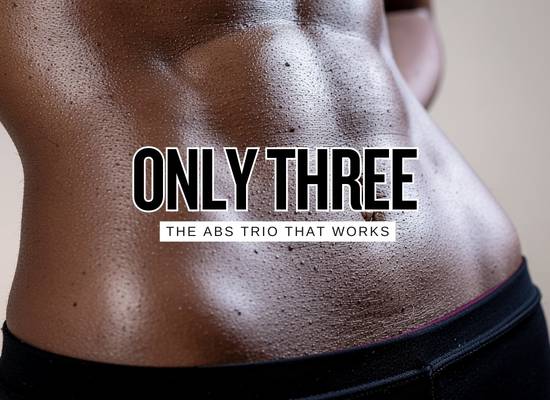
Most ab routines fail because they chase burn, not results. If you only had three moves, the smartest trio covers the core’s biggest jobs: resist extension (keep ribs stacked and waist tight), resist rotation (build a stiff “belt” through the torso), and produce controlled flexion (build the ab blocks you can actually see). The three exercises below hit those jobs hard, scale cleanly, and show up in posture, performance, and definition.
Visible abs come from leanness plus a torso that stays stacked and controlled. If only three exercises are available, the best trio covers: anti-extension (tight waist posture), anti-rotation (belt-like stability), and controlled flexion (ab thickness).
- One move that punishes rib flare so posture and waist control improve fast.
- One move that punishes twisting so the core acts like a stable cylinder under load.
- One move that builds visible ab thickness with slow control instead of momentum.
| Exercise | Main job | Big difference it makes | Most common mistake | Video |
|---|---|---|---|---|
| ① Ab Wheel Rollout | Anti-extension | Forces ribs down and teaches the abs to stop low-back arching, which tightens the look of the whole torso | Rolling too far and turning it into a low-back arch | Open video |
| ② Pallof Press | Anti-rotation | Builds belt-like stiffness through the obliques so the waist stays stable during lifting, sprinting, and daily movement | Leaning and twisting to finish the rep | Open video |
| ③ Hanging Knee Raise | Controlled flexion | Builds visible lower-ab control and teaches a clean pelvis curl without swinging | Using momentum and hip flexors instead of abs | Open video |
① Ab Wheel Rollout
This is the fastest honesty test for rib flare. When the abs fail, the low back arches. When the abs win, the torso stays stacked and tight. That stacking effect is one of the biggest “abs look better” upgrades even before extreme leanness.
- Trains the abs as a brace: the job is stopping extension, not creating a burn.
- Improves waist posture: better rib position makes the midsection look tighter in shirts and photos.
- Easy progression: range is the progression knob. A little farther each week is real overload.
- Exhale first: long exhale to bring ribs down, then start the rollout.
- Glutes on: light squeeze helps keep the pelvis from tilting forward.
- Short range beats sloppy range: the rep ends one inch before the low back wants to arch.
- Return with abs: the pull back should feel like the abs dragging the wheel in, not a hip snap.
- Beginner: kneeling rollout to a short range, pause, return
- Intermediate: longer kneeling range plus 1-second pause at the far point
- Advanced: standing rollouts via incline, or longer lever variations
② Pallof Press
This is the move that makes the waist behave like a solid cylinder. It builds the anti-rotation strength that keeps your torso from leaking power and posture when you move, lift, and breathe under load.
- Obliques without twisting reps: builds a tight midsection look without relying on endless side bends.
- Carryover to everything: stable torso improves lifts, carries, and athletic movement.
- Teaches controlled breathing: bracing while breathing is the real-life core skill.
- Ribs down: avoid flaring the ribs to feel stronger.
- Hips quiet: no shifting toward the cable or band, no leaning away.
- Pause reps: a 1 to 2 second pause at full extension makes it honest.
- Control the return: the return is not a collapse, it is resisted.
- Beginner: half-kneeling Pallof press
- Intermediate: tall-kneeling and standing Pallof press
- Advanced: split-stance Pallof press, offset stance, longer pauses
③ Hanging Knee Raise
This move is controlled flexion with gravity. When done clean, it builds visible lower-ab control and teaches the pelvis curl that separates abs from hip-flexor work.
- Builds visible control: the top of the rep is the money spot, a small pelvis curl with no swing.
- Improves core sequencing: abs initiate and finish the rep instead of hip flexors taking over.
- Scales well: pauses and tempo make it harder without turning it into flailing.
- Start from still: no swinging start, grip tight, shoulders packed down.
- Knees up, then pelvis: bring knees up, then finish with a small curl of the pelvis.
- Slow lower: 2 to 3 seconds down with control keeps it ab-driven.
- Stop before swing: if the body starts to swing, the set is done.
- Beginner: captain’s chair knee raises or supported raises
- Intermediate: strict hanging knee raise with pause at the top
- Advanced: straighter leg raises with strict tempo, no kip
| Day | Ab Wheel | Pallof Press | Hanging Knee Raise | Progression focus |
|---|---|---|---|---|
| Day 1 | 3 sets, short strict range | 3 sets, pause reps | 3 sets, slow lowering | Clean form baseline |
| Day 2 | 3 sets, add a small range | 3 sets, longer pause | 3 sets, add pause at top | Time and control |
| Day 3 | 2 to 4 sets, best range of week | 3 to 4 sets, slightly more load | 3 to 4 sets, best strict reps | Small overload |
This builder outputs a clean session structure and progression target based on time, level, and equipment.
- These three moves cover the core jobs that matter most for posture, stability, and visible thickness.
- Definition still depends on leanness so nutrition consistency remains the main driver of “pop.”
- Progression is the difference small weekly upgrades beat random high-rep burn sessions.